LESS EGO / MORE SOUL

LESS EGO / MORE SOUL
  • rss
  • Home
  • Latest Articles
  • Offerings
  • SUBSTANCE
  • Contact
  • About
    • Jiveny

Therapy, Yoga and Spiritual Practice: Exploring the Beauty of Dysfunction – Part 1 of 2

jiveny | March 27, 2012

Passion by =lucid-light


I’ve been falling in love with the cosmic teachings of David Deida all over again. If you’re not familiar with his work as the shaman of romance, then get familiar here.

One message that particularly sticks out in my mind is his metaphor of the human condition using the analogy of a stained-glass window. Here, Deida describes the differences between therapy, yoga and spiritual practice.

Allow me to walk you through it.

Imagine that you are a stained glass window, and as you come into consciousness, you look down upon yourself as you try to determine what you really are.

Now, unfortunately from this limited perspective, you can’t see the whole beauty of your form. Instead you find yourself focusing on all of the mismatched shards of glass – some with cracks and gaping wholes. As you examine yourself you come to the conclusion “oh-no! I’m broken…” and with this realization, the ego leads you to believe that you need this or that to be better, whole and complete.

This is the definition of therapy, where we look at ourselves critically with a view to “replace the glass” by learning the psychological skills needed to better function in our society. Of course, therapy is a completely valid viewpoint and an important journey to take as we each endeavor to evolve and grow into the highest expression of our human potential. However, it is also important to remember that this is not the whole picture, nor the ultimate solution to one’s suffering.

In contrast, yoga is more like “wiping the dust off the glass”. It is an art form. [And how often does great art arise form the twisted and chaotic?] Rather than seeking to fix the parts of you that are “broken”, yoga demonstrates how to move energy through form, so that we may flow with life more easily. In truth, one can be entirely dysfunctional psychologically, and still do good yoga (and many yogis are).

Finally, spiritual practice can be summarized as realizing that you are both the stained glass window AND the light that shines through it. In these moments of enlightenment there is very little motivation to “fix” yourself. One can be contorted, broken, blocked and flawed and still realize that they are essentially light – and that is a humbling notion.

This third point of view is an incredibly powerful tool, as it allows us to stop putting life on hold, hiding behind the excuses of “I’m not ready yet” or “once I have this, I will be enough”.

As we learn to identify with the bigger picture – embracing the full glory of our being, flaws ‘n’ all, we can begin to live the life we have always dreamed of NOW, whilst simultaneously embarking upon our therapeutic journey.


Comments
2 Comments »
Categories
Conditioning, Ego, Life / Spirituality, Sex, Love, Relationships, Soul
Tags
beauty, blocked, broken, david, deida, ego, Enlightenment, flawed, form, glass, light, love, practice, romance, self, sexuality, shaman, spiritual, stained, therapy, twisted, window, yoga
Comments rss Comments rss
Trackback Trackback

The Humble Truth

jiveny | March 20, 2012

How to be humble? As a musician and an artist I’ve been exploring how to perform my art in a way that allows me to fully self-express my work from a position of humility. Here are my observations on the journey…

To be humble is to do your best with a smile.

It’s to make yourself vulnerable as you share yourself with another.

It’s to share your art without holding back.

I hope you’ve witnessed a truly humble performance in your lifetime. The way it pulls at your heartstrings and invites you to melt into the present, knowing that this is it – the divine manifesting – right here, right NOW.

That is how I feel when I witness my favorite artists performing anyway.

Regardless, somehow I had adopted the twisted idea that being humble was more about being modest. That is, in the deluded sense that I should “dim my light”.

Don’t you be too good, clever or impressive now – you’ll make other people uncomfortable… seemed to be the implicit message.

It took me a while to figure it out, but I’ve decided that being humble is actually about shining your light REALLY bright. Full power. Burn baby burn.

After all, it is by being comfortable with oneself and our talents as individuals, that we are able to give others permission to develop their own talents and shine.

None of that “But who am I to be so shiny?” bullshit.

Whatever your talent, it is your gift to the world, and consequently, your responsibility to share it fully with others, as a reminder of the inherent divinity that lies within all of us.

Fear might try and restrain you, sure, but experience will tell you that fear is a liar with a convincing tongue.

Comments
1 Comment »
Categories
Conditioning, Culture, Ego, How-to, Life / Spirituality, Notes to Self, Soul
Tags
Artists, dim, divine, divinity, ego, fear, gifts, here, humble, liar, light, manifest, marianne williamson, modest, now, performance, present, shine, Talent, the id, vulnerable
Comments rss Comments rss
Trackback Trackback

Fear & Personal Power – What Holds Us Back

jiveny | March 6, 2012


What is it that holds us back from claiming our own personal power; from being the best version of ourselves we possibly could be?

If you are anything like me, you’ve probably found yourself tugging at the skirt of your ultimate-self-vision with frustration every once in a while. Habits seem too stubborn; addictions too intoxicating. Match that with some underlying beliefs of unworthiness, and you’ll be forever tugging at that skirt.

But lets examine the situation a little more closely; as while the transformation into the highest expression of our self, might seem daunting, we all live with the hope that it is possible. And it is possible. You’ve seen yourself change for the better before; you’ve seen others change for the better before. Change is always possible, so the question remains: what holds us back?

A large part of the human story is this idea that “humanity is flawed”. That humans are incompetent in handling power. That we are not worthy, nor good enough to deal with the responsibilities that power entails.

This message has been perpetuated throughout our culture for thousands of years, through centuries of mythology. You needn’t look hard for examples – Adam and Eve’s original sin – Man’s “fall from grace” is perhaps the most prominent evidence of this brainwashing in action. This has led to a deeply embedded sub-conscious fear of power – reinforced by an insecurity of unworthiness.

Yet, we continue to seek our power; in fact we crave it because it is our birthright. Were you not born to rein over your own body, inspiring it to express your highest vision of self?

In light of this, it seems that whenever we get close to the edge of our own personal power, it scares the shit out of us, and so we run, putting as much space between it and ourselves as possible.

The mere idea that we could change instantaneously puts us up there with “the gods” and though our western culture might appear to contradict this theory as our governments struggles to own this god-like power, we perceive the responsibilities of “gods” as far too much for ourselves to handle. “Humanity is flawed after all,” whispers mother culture, and so, we fall back into old habits, sub-consciously self-sabotaging our dreams, trying less than our best in order to fit in and save face.

The truth is, we are powerful expressions of the divine. After all, were we not made in the image of the divine creator? All it takes to be who we want to be is a change of mind. Yet, this personal power is scary, because with the capacity to change our minds at will, we become unstoppable as we move through the flow of life, learning and transforming ourselves for the better.

Unfortunately, because we don’t trust ourselves with power (and we certainly don’t trust others of our kind with it) our subconscious will do anything to keep us from changing quickly and sustainably. And so the cycle begins, where we bring ourselves down to the level of those around us – for fear of becoming a prosecuted scapegoat (like Jesus). We also pull others around us down with our lack of confidence in their ability to handle power responsibly.

Considering how many times I have been disappointed by examples of humans who have used power irresponsibly, I will admit that this isn’t a completely unwarranted fear. However, it is important to distinguish that these painful cases are ALWAYS instances where humans have attempted to claim power over others. This is the power of domination that dominates our culture as leaders attempt to enforce their vision and their unique perspective onto others.

This never works, of course, as the point of being human is to experience a unique perspective and to make choices related to one’s own individual paradigm. There is no such thing as an answer that is fitting for all, which is why it is so important that we learn to govern ourselves with confidence and dedication in using our bodies to express ourselves authentically. After all, do you not trust yourself to be the captain of your own soul?

So let me be clear, when I talk about “claiming your own personal power”, I’m actually talking about embracing domination’s better looking sister – the power of dominion (power with others).

While the power of domination thrives on the concept of limitation; that “the more I have, the less you get”, the power of dominion, celebrates the power we have when we step up to the challenge of expressing ourselves in all our glory. This is the power that allows us to inspire one another to live a life of liberated authenticity. This is the power that allows you to not only touch your dreams, but experience them in reality. This is the power that generates sustainable success.

So I’m practicing embracing it without fear; to make the choice to change my mind and kick the habits that keep me from expressing who I really am.

And so I remind myself to stop trying - instead, to choose something and be it.

Comments
No Comments »
Categories
Conditioning, Culture, Ego, Life / Spirituality, Lifestyle, Notes to Self, Soul
Tags
adam, body, conditioning, Culture, divine, domination, dominion, ego, eve, expression, fall from grace, fear, gods, government, human, man, personal, power, responsibility, self, soul, transformation, unworthy
Comments rss Comments rss
Trackback Trackback

Be Brave and Speak Consciously – NLP & The Power of Words

jiveny | February 22, 2012

My body is a blank canvas.

Language is the paint and my mind is the artist.

Animals, plants and objects may be art but language is not their medium.

They are more like sculptures, as my words have no effect on them.

In contrast, language has the power to influence my own form dramatically.

I am who I think I am (or perhaps even more accurately at times, who I fear I am) as my words and actions manifest my thoughts.

In lieu of this, I’ve been thinking about how my own self-doubt is the only thing that separates me from those who I feel inferior to, or inspired by.

Sadly, I tend to augment my own self-doubt with the language I use to define my perspective.

It has been said that life mimics art just as art mimics life. In every moment, conscious or dreaming, we’re telling ourselves a story, and the stories we tell ourselves develop our character. In short, we’re writing our reality and it all starts with the language we use.

Delving a little deeper, I’ve observed how commonly we refer to ourselves in the third person when speaking of our own thoughts and feelings (I’m doing it right now in fact).

It’s a curious thing…

In NLP (Neuro-Linguistic Programming), psychologists explain the importance of using “I statements” when expressing oneself. That is, using I instead of we. For example, I should say: “I’ve observed how I commonly refer to myself in the third person when speaking of my own thoughts and feelings”.

I statements force the speaker to take responsibility for their own perspective rather than attempting to suppress and disguise it as a collective issue or agreement. This negligence of responsibility inhibits real change in the name of fearless self-development as we program ourselves to think that our issues are not really ours (when they are). After all, change starts with the individual.

Granted, there are collective issues and agreements that pervade our reality, where it is entirely acceptable to speak in third. However, let us consider how speaking in third person limits the human experience.

When I take responsibility for myself through conscious speech (using I statements) I liberate my being as I validate my own personal point of view. In contrast, when speaking in third person, I neglect to own my thoughts and feelings, sending the sub-conscious message that its not really my problem, and, more destructively, that I do not have the right to feel these things as an individual.

Using I statements also prevents the speaker from imposing their reality on to the listener. I’m sure you’ve heard people describing their own unique experiences with travel, yoga, skydiving, Entheogens, or whatever else, as if their experience was definitive. They might say: “You’ll love it, it’s so amazing, when you get there, this happens and then this happens and it feels like this…” etc.

This is my issue with religious fanatics as texts such as the Bible are really just stories of other people’s experiences with source. By passing them on with the seriousness that we do, we prevent one another from being present and experiencing our own sacred stories of life, source and reality.

Sure there is truth and wisdom in each story – but rather than taking them on as gospel, its important to recognise that there is no definitive guide to life’s mystery outside of one’s own mind.

Personally, I think story telling is a good, natural and beautiful aspect of being human. However, to be responsible speakers and storytellers we need to be clear (for our own sake and others) that our personal experiences are uniquely ours. We may find others who have similar experiences, but that is still no cause to attempt to portray them as a definitive example of what it means to be alive and kicking.

Now, I realise I am being somewhat hypocritical with the tense I have written part of this article in. Granted, third person is a hard habit to break and I am still exploring how to incorporate it into my writing. However, “babies learn to crawl before they learn to walk” and so I am still working on it as I invite you to join me.

Comments
No Comments »
Categories
Conditioning, Culture, Ego, Life / Spirituality, Lifestyle, Notes to Self, Soul
Tags
art, bible, body, change, character, collective, conscious, define, development, dreaming, experience, fearless self-discovery, human, I statements, individual, inferior, influence, Inspired, language, meaning, Neuro-linguistic, NLP, perspective, point of view, programming, psychology, reality, religious, responsibility, self development, self-doubt, source, speech, stories, story, story-telling, tense, texts, third person, words
Comments rss Comments rss
Trackback Trackback

The Wisdom of Trees

jiveny | January 31, 2012

I’ve been thinking a lot about the wisdom of trees lately. My experiences in working with Ayahuasca only confirmed my long-time suspicion that within each plant lies a sentient being.

To me, they represent one of the purest states of consciousness, remaining so still and open energetically, as if in a constant state of zen meditation.

In a previous post I used the metaphor of an apple tree as being the epitome of unconditional love. It bears it’s fruit so generously without expectation or concern for who or how it is consumed.

Recently I was standing at the edge of a forest, admiring nature’s wild beauty when four colourful parrots flew over my head and landed in a nearby tree. They were gorgeous creatures of red and blue feathers and I considered how cool it would be to have them come to me. I stood there meditating, connecting with them for a few moments, setting my intention. When the time was right, they flew toward me, but all I could do was flinch, duck and laugh at myself.

I can only begin to imagine what it would be like to be as energetically open as a tree.

One of the many lessons nature has taught me along my journey is that one of the keys to life is to make others feel welcome – particularly through sharing.

Tarot talks about the wisdom of being the fool – to be open and open and still open to life, no matter the potential for pain and suffering. This allows one to maintain the innocence and fearless enchantment of a child.

In my mind, trees demonstrate this beautifully as the forest shares everything – it is open and open and still open like a fool. Friend or foe, a plant does not show any fear – whether its approached by a tree-hugging hippy, or a ferocious chainsaw. It stands before both, radiating isness as if to say simply: “I am, until I am not.”

At times we might fear the dangers of the outside world, but despite it all, trees stand strong and tend to live long. Their resilience to the fear mentality that imbues our human condition inspires me, reminding me of the world I knew in my younger days, where fear was no thing and the possibilities of what I could do and create with my life were limitless.

…

A friend of mine once pointed out to me, “you know all they want is your appreciation” and so I make a point to give it to them. They give us so much after all – food, shade, oxygen, and if you are willing to listen (as they whisper ever so softly) wisdom.


Comments
1 Comment »
Categories
Ego, Entheogens, Inspiration, Life / Spirituality, Soul
Tags
appreciation, AYAHUASCA, beauty, child, colourful, consciousness, fear, foe, fool, friend, I am, imagine, innocence, Inspiration, learn, meditation, nature, Pain, parrots, plant, suffering, tarot, tree, trees, wild, zen
Comments rss Comments rss
Trackback Trackback

Reclaiming Symmetry – The Power of Posture

jiveny | January 23, 2012

I have a new yogic practice…

It involves maintaining open, symmetrical body language throughout my daily movements.

As I sit, stand, walk and move my aim is to have the left and the right sides of my body mirroring each other, without crossing the central axis of my spine. This is the way a young child or an animal will often express themselves when they are relaxed and at peace.

Being conscious about my posture in this way allows my energy to flow freely. It also symbolizes my openness to life, experiences and others. This is a powerful practice because it is through our own symbolic actions that our sub-concious communicates.

Interestingly, my ego is not so fond of this really simple practice. I think it finds it confronting to be so open – to allow myself to appear vulnerable. This requires more of a conscious effort on my part – reminding myself that there is nothing “out there” to fear.

I know from my yoga practice how common it is in our modern lifestyle to maintain a hunched, closed posture as we attempt to shield our vulnerabilities from the outside world. In many subtle ways, I find this reinforces our separation conditioning of fear as we “protect” ourselves from what we no longer consider a part of “us”.

This is why I am making a conscious effort to use this practice as a way to soften my ego. After all, it is by making ourselves vulnerable that we eventually become invulnerable.

Comments
1 Comment »
Categories
Conditioning, Ego, Life / Spirituality, Lifestyle, Soul
Tags
animal, body, child, conditioning, conscious, creatures, daily, ego, language, mirror, movement, peace, practice, separation, soul, symbol, symbolism, symmetry, vulnerable, yoga, yogic
Comments rss Comments rss
Trackback Trackback
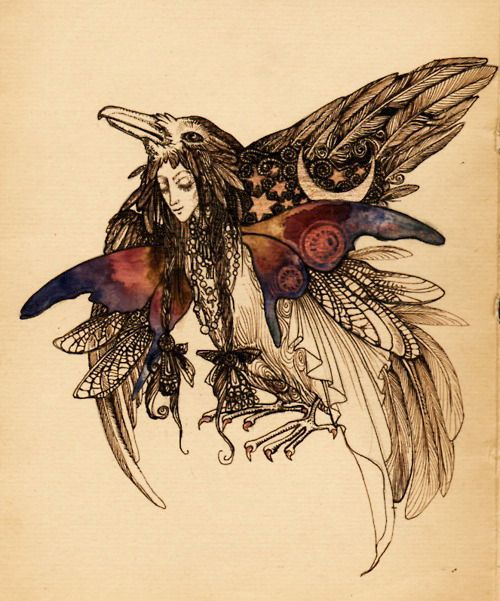
Forgiveness, Suffering, Morality and The Art of (De-)Personification

jiveny | October 26, 2011


I say, personify and de-personify everything. For it is these boundaries of alienation that lead us to suffering as they limit us from accepting things as they are and fully understanding the interconnectedness that surrounds us.

For example: Forgiveness is a tool of the ego, allowing us to pacify our own self-entitlement. While societal conditioning might have us believe that it is an act of grace that we bestow upon others so generously, the truth is, our ability to forgive does not make us a “better” person. It makes us a more “functional” person as it cradles our wounded ego in the face of “offensive behaviour”.

If you kick your toe into a wall, do you feel the need to forgive the wall for the pain it has caused you?

If a wild animal eats some food you’ve left out in the open, do you feel the need to forgive the animal?

Some might feel this way, but most do not. Yet we tend to hold this expectation that another human’s transgressions against one’s own view of morality MUST be forgiven or else we cannot move on.

For this reason, I try not to see the world through the limited lens of “right” and “wrong”, “good” and “bad”.

In my worldview, we are all just wounded animals trying our best to get along and move on from the scars of our past. No one does anything that contradicts his or her own perception of what is right and good. However, all of us are programmed by past wounds to act as we do in order to avoid future suffering of the same kind.

Understand that fear, in one form or another inspires 100% of humanity’s “wrongdoings”.


Comments
No Comments »
Categories
Conditioning, Ego, Life / Spirituality
Tags
alien, alienation, animals, bad, behaviour, depersonify, ego, forgive, forgiveness, good, offense, Pain, Past, personify, right, scars, soul, tool, wounded, wrong
Comments rss Comments rss
Trackback Trackback

The Suffering of We Wounded Animals

jiveny | October 15, 2011


A lot of people tend to view the world through the narrow filters of “right” and “wrong”.

I just see a bunch of wounded animals trying their best to heal themselves and get along.

Is the world of a predatory or benevolent nature?

Are we right to fear the unknown?

We certainly see nature display a predatory theme as death claims life with reckless abandon.

However, this is not the opposite to benevolence. For nature knows the importance of harmony and balance far better than we do, offering ecstasy in each little death.

Silently, she encourages us to take what we need and leave the rest alone, for it is out of need (not greed) that we may take without consequence.

But driven by greed, our society has been conditioned to take more than we need.

And so we find ourselves addicted to consumption; to having and devouring as much as we can in our lifetime.

This is our reaction in an effort to reclaim ourselves; to fill the gaping hole that has wounded our soul as we consume ourselves,

bite by bite,

   moment by moment,

  slowly from the inside out.


Comments
1 Comment »
Categories
Conditioning, Culture, Ego, Life / Spirituality, Lifestyle, Soul
Tags
animals, benevolence, bite, conditioning, consequence, consume, death, fear, filter, greed, life, moment, nature, need, ourselves, predator, reclaim, right, soul, suffering, transformation, unknown, world, wound, wounded, wrong
Comments rss Comments rss
Trackback Trackback
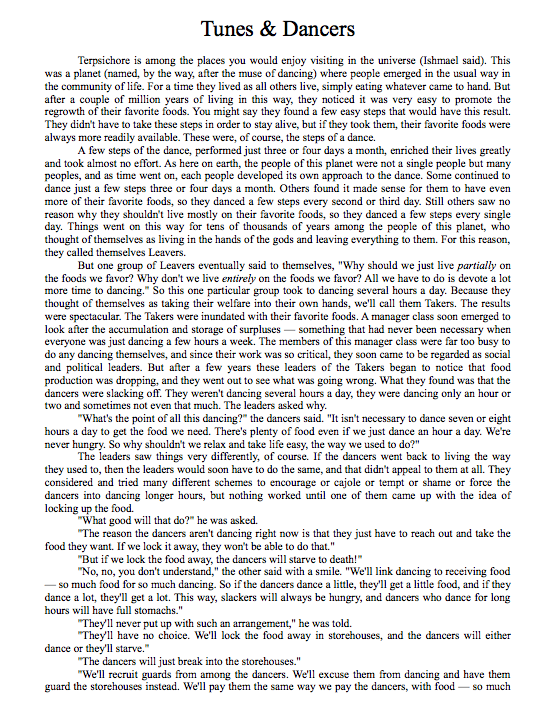
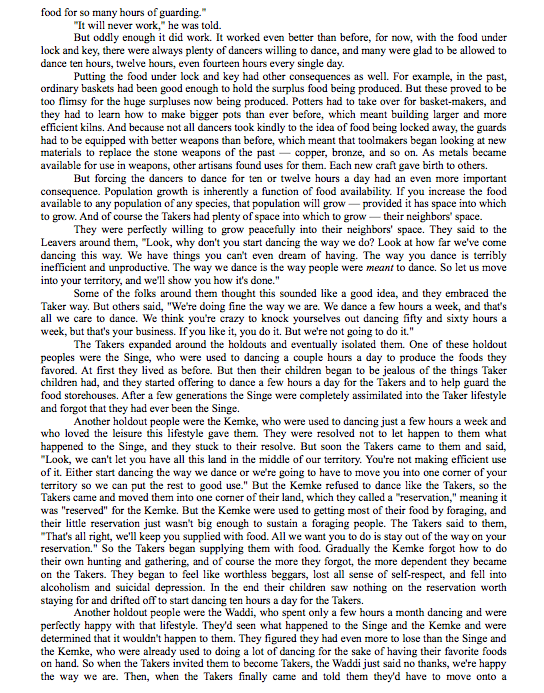
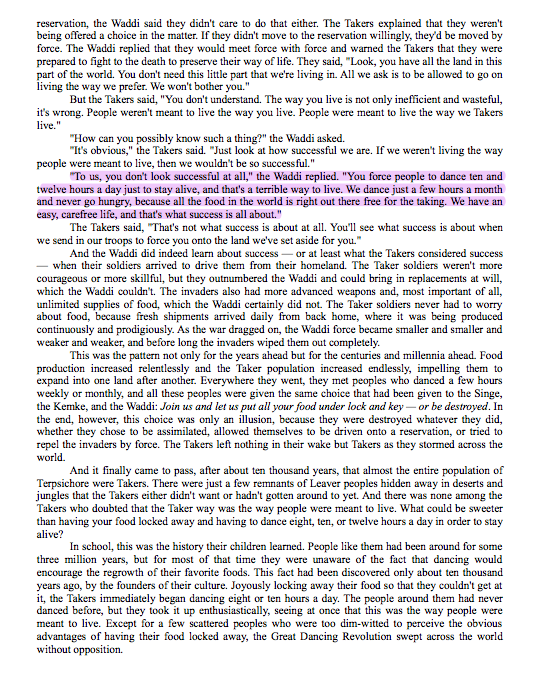
Tunes & Dancers – A Parable by Daniel Quinn Exploring True Success

jiveny | October 5, 2011


I can’t get this parable out of my head, so I wanted to share it with you. It is an excerpt from A book by Daniel Quinn – My Ishmael (1997).

You can click on the images to enlarge. Please comment to discuss.

Comments
2 Comments »
Categories
Conditioning, Culture, Ego, Lifestyle
Tags
conditioning, Culture, Daniel Quinn, Ishmael, Leavers, My Ishmael, Success, Takers, true, Tuners & Dancers
Comments rss Comments rss
Trackback Trackback
FEAR & LOVE – The Power of Love vs. The Illusion of Fear

jiveny | September 19, 2011


It’s been said that there are only two true emotions we humans can ever really express. That is, FEAR and LOVE.

All other feelings are just variations on these common themes.

Happiness, joy, pleasure and peace? That’s love baby.

Hate, depression, guilt and anger? That’s fear my friend.

Fear is a common programming in society’s crusade for control and order. It is after all, a very powerful motivator that often drives us to react on impulse.

Most of all, we tend to fear the unknown and so we base our choices on past instances; favoring the maintenance of the world as we know it, over the possibility of something else and perhaps far greater.

In this way, we tend to adopt the coping mechanisms of our parents, teachers, peers etc. without much awareness.

In essence, fear drives the power of domination – thebelief in the great myth* of the jungle – “kill or be killed; eat or be eaten”.

In contrast, love has but one law: “Do no harm”.

Love is connection / Fear is separation.

Love is communion / Fear is isolation.

We can share and communicate love, but it is our fear that is inexpressible…

Because fear is our own personal illusion, while love is our common reality.

+++

*I call this a myth because the actual law of the wild is “take what you need and leave the rest alone” but that’s another story, for another day.

Comments
3 Comments »
Categories
Conditioning, Ego, Life / Spirituality, Soul
Tags
choice, communication, communion, conidtioning, Culture, depression, emotion, fear, feelings, greed, guilt and anger, happiness, harm, harmless, hate, isolation, joy, jungle, kill, law, love, maintenance, myth, need, peace, pleasure, possibility, reality, society, themes, unkown, variations, wild, wold
Comments rss Comments rss
Trackback Trackback
Sacred Economics

jiveny | August 17, 2011

Even after all this time
The sun never says to the earth,

“You owe Me.”
Look what happens
 with a love like that,
It lights the Whole Sky.
—Hafiz

Recently I have been following the work of Charles Eisenstein in his exploration of what he calls “Sacred Economics”. In his book, he explores our historical relationship to money, it’s original purpose and the now warped addiction we have to paper, metal and plastic in this “Age of Separation”.

There are three points he makes that I would like to summarise here, as these insights have really inspired me to adopt a healthier relationship with the universe…

1. We are all born helpless infants; creatures of pure need with little resources to recipricate, yet we are fed, protected, clothed, held and soothed, without having done anything to “deserve it”. This experience, common to everyone who has made it past childhood, informs some of our deepest spiritual intuitions. Our lives are given us; therefore, our default state is gratitude. This is the truth of our existence.

“No wonder ancient religious thinkers said that God made the world, and no wonder they said God gave the world to us. The first is an expression of humility, the second of gratitude. Sadly, later theologians twisted this realization to mean, “God gave us the world to exploit, to master, to dominate.” Such an interpretation is contrary to the spirit of the original realization. Humility knows that this Gift is beyond our ability to master. Gratitude knows that we honor, or dishonor, the giver of a gift by how we use it.”

2. Everything that is sold today was originally a part of the commons – included in the package of life, for all of us to enjoy. As our society has progressed into this Age of Separation however, elements of our communal wealth have been, in effect, stolen to create the commodities traded throughout the world today. You can trace all the materials used for a thing, back to its natural source. This idea of property has perpetuated the ego’s attachment to “mine” and “yours” as we divide our world into increasingly smaller fragments. This is a wound we all feel subconsciously and is perhaps most obvious in the example of property. No longer do we have the luxury to enjoy nature’s beauty like the free animals we were born to be, as our land has been divided and christened with signs proclaiming “PRIVATE PROPERTY – KEEP OUT”.

Take a walk through the country and all humans are bound by the laws of trespassing to stick to the dusty main road while a swallow may carelessly explore whatever territory it wishes.

3. “The urge to own grows in natural response to an alienating ideology that severs felt connections and leaves us alone in the universe. When we exclude world from self, the tiny, lonely identity that remains has a voracious need to claim as much as possible of that lost beingness for its own. “If all the world, all of life and earth, is no longer me, I can at least compensate by making it mine.” Other separate selves do the same, so we live in a world of competition and omnipresent anxiety. It is built into our self-definition. This is the deficit of being, the deficit of soul, into which we are born. And, because there is no apparent limit to what money can buy, our desire for money tends to be unlimited as well.”

I encourage you to indulge your mind in the brilliance of his writing, on a subject that is important for all of us to understand.

You can read Sacred Economics online for free here.

Comments
1 Comment »
Categories
Conditioning, Culture, Ego, Life / Spirituality, Lifestyle, People, Soul
Tags
Charles, conditioning, Economics, Economy, ego, Eisenstein, Freedom, gift, God, history, identity, money, natural, property, Reality Sandwich, relationship, Sacred, separation, trespassing, understanding, universe, world, wound
Comments rss Comments rss
Trackback Trackback

« Previous Entries Next Entries »

Seek and ye shall find

Subscribe to the Blog

View Random Post

Click here to read a random post

Categories

  • Conditioning
  • Culture
  • Ego
  • Entheogens
  • Health
  • How-to
  • Inspiration
  • Life / Spirituality
  • Lifestyle
  • Music
  • Notes to Self
  • People
  • Poetry
  • Quotes
  • Sex, Love, Relationships
  • Soul
  • Travel
  • Uncategorized

Recent Posts

  • My V-DAY shave!
  • Prayer For The Water
  • JIVENY – Live On 106.2FM – Tel Aviv
  • How To Manifest A Fundraiser – The Sweat Lodge
  • Sex, Intimacy & The Art of Desire

Recent Comments

  • jiveny on Power: Dominion vs Domination
  • jiveny on Power: Dominion vs Domination
  • Rishi on Home
  • Kaia on Power: Dominion vs Domination
  • beginning of d day june 6 1944 on The Loss of Childhood Innocence

Top Rated

Subscribe by RSS
Subscribe by Email:
Delivered by FeedBurner

Tags

alive AYAHUASCA beauty body change choice conditioning divine earth ego energy enough existence expectations experience Failure fear feeling Freedom God good happiness human judgement life live love mind money Neal Donald Walsch Pain philosophy present quote reality relationships self soul Spirituality suffering Travel truth understanding wisdom wrong
+Jiveny Blair-West